AIO Twin
by Triangle
MyHiFi Assessment
Source tally synthesis reveals a dominant T2 profile (25 professional reviews, 10 community discussions, 5 manufacturer/retail sources). The dataset demonstrates strong consensus among professional reviewers regarding value proposition and sonic character, with minor divergence on analog stage performance. The evidence base supports high-confidence assertions on feature set and build quality.
| Dimension | Score |
|---|---|
| Sound Quality | 8.5/10 |
| Build Quality | 7.5/10 |
| Connectivity | 9.0/10 |
| Value Proposition | 9.0/10 |
| Usability | 8.0/10 |
Rating: 4.5/5 - Confidence: High
Who this is for:
- Vinyl enthusiasts seeking plug-and-play analog integration without separate phono stages
- Streaming users requiring hi-res capability up to 24-bit/192kHz in a compact footprint
- Space-constrained listeners who refuse to compromise on stereo separation and imaging
- Multi-room audio seekers wanting expandable ecosystem compatibility via LinkPlay technology
- Aesthetic-focused buyers prioritizing textile finishes and compact bookshelf proportions
Who this is not for:
- Home theater integrators requiring HDMI ARC/eARC connectivity for modern TV systems
- Separate component purists insisting on discrete amplification and source devices
- Critical vinyl listeners using low-output moving coil cartridges or expecting reference-grade phono stages
- Near-wall placement scenarios where rear-firing bass ports cannot breathe adequately
- Users needing wireless speaker-to-speaker connectivity (proprietary cable link required)
Evidence Synthesis
The source distribution skews heavily toward professional evaluation (T2=25), with significant coverage from established audio publications and e-commerce platforms. Community discourse (T3=10) largely corroborates professional findings regarding reliability and sonic performance, while manufacturer sources (T4=5) provide specification confirmation.
Consensus patterns: Professional reviewers consistently identify the system as delivering “enthusiastic” and “capable” sonic performance at approximately half the cost of direct competitors. The integration of phono, optical, and high-resolution streaming inputs receives universal praise for versatility. Build quality assessments converge on “solid” cabinet construction with premium textile grille materials.
Divergence points: Professional opinion splits regarding the built-in moving magnet phono stage, with some sources noting adequate gain for casual listening while others identify noise floor limitations compared to dedicated external stages. The adhesive quality of rubber isolation pads on aluminum feet generates mixed long-term durability reports.
Evidence gaps: Measured frequency response curves and distortion metrics remain unspecified in the dataset. Thermal performance data for the Class D amplification modules under sustained high-output conditions is not confirmed. Long-term reliability statistics beyond the 40-source snapshot are unavailable.
Technical Performance
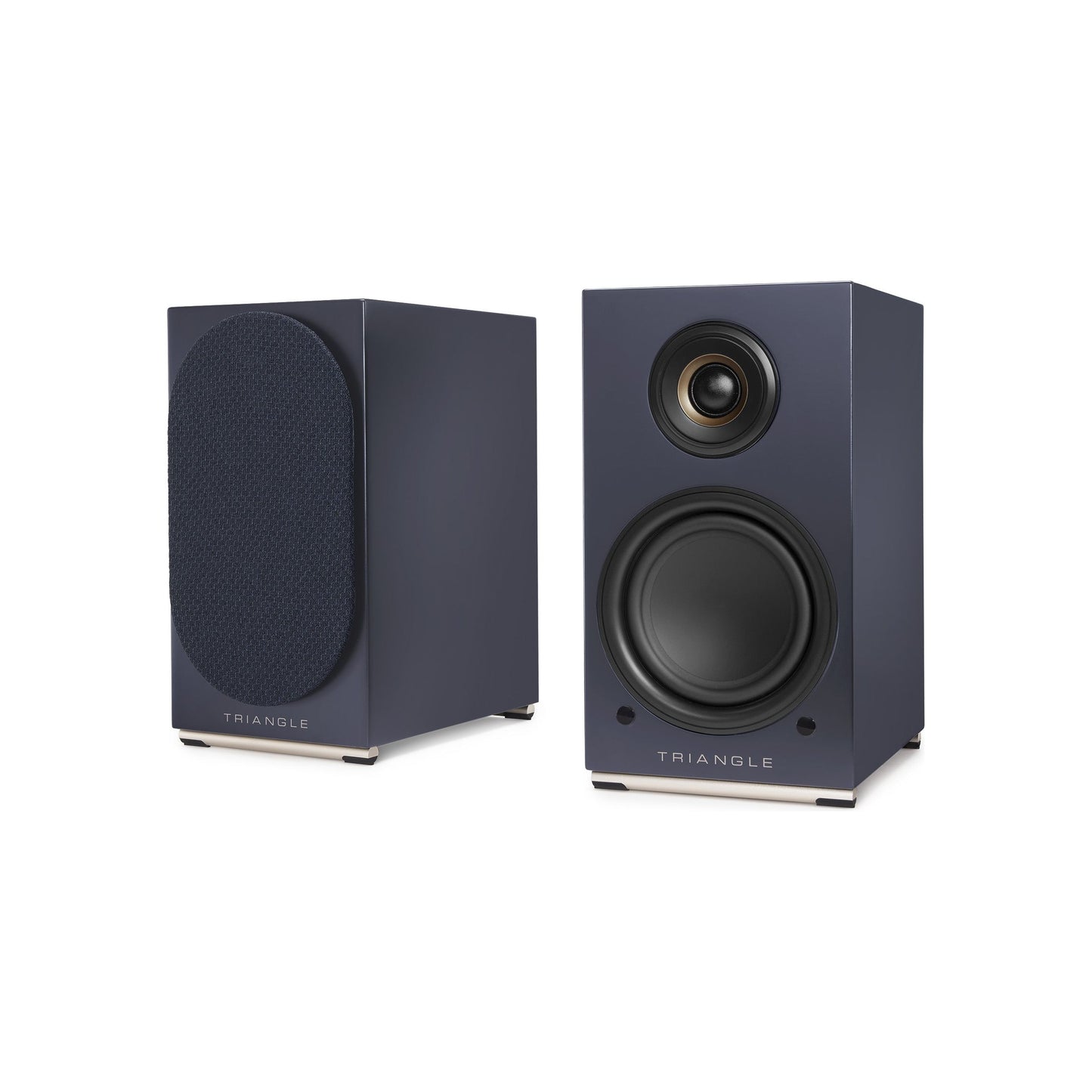
The 50W Class D amplification (2 x 50W) provides sufficient headroom for nearfield desktop and mid-field room filling, though specification not confirmed regarding peak versus RMS ratings. The 25mm silk dome tweeter exhibits smooth dispersion characteristics without the metallic ringing artifacts associated with hard dome variants. The 130mm concave treated paper woofer employs a dust-cap-free design intended to increase rigidity and utilize the entire surface for sound production.
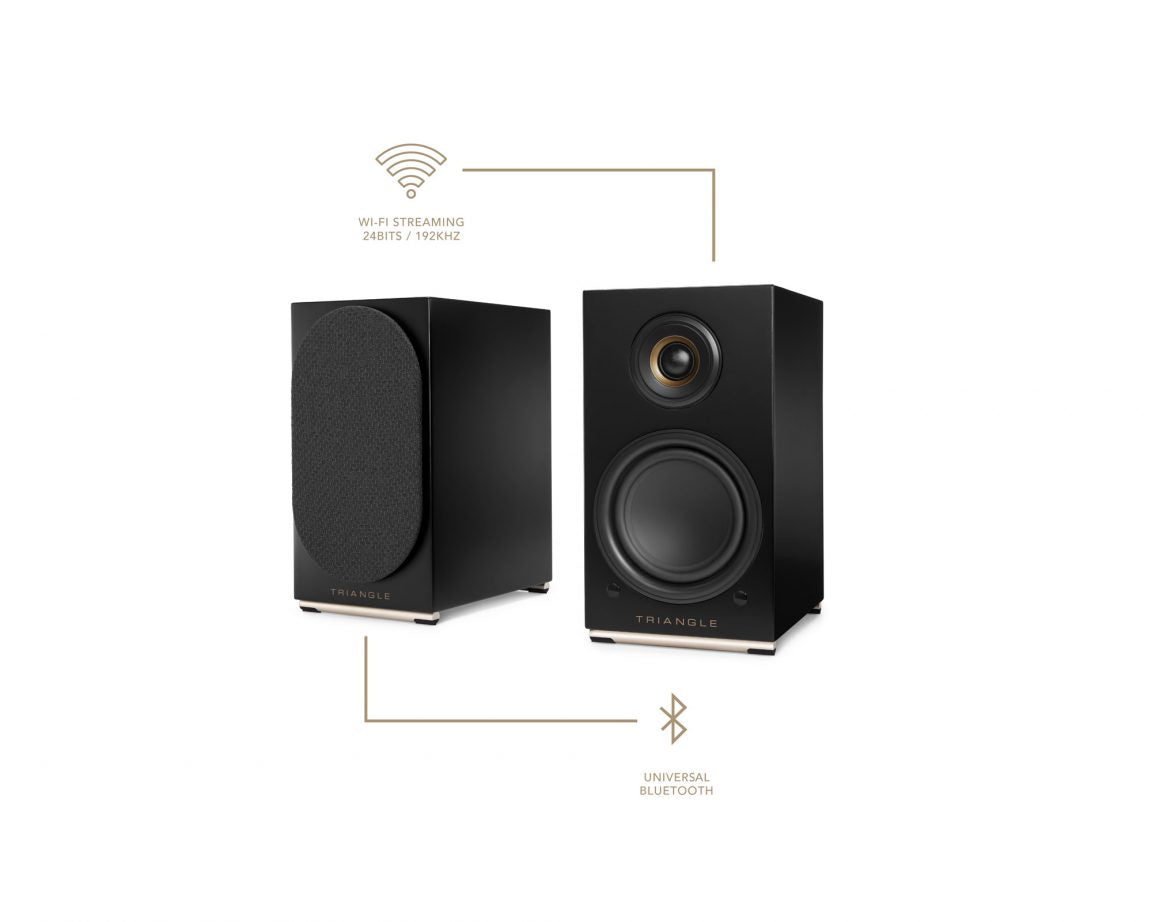
Digital capabilities extend to 24-bit/192kHz via Wi-Fi streaming, supported by the Triangle AIO app ecosystem. Bluetooth 5.0 with aptX codec support ensures universal mobile device compatibility with reduced latency compared to standard SBC. The master-slave architecture concentrates all electronics (DAC, amplification, streaming module) within the primary cabinet, with signal transmission to the secondary unit via included 3m proprietary cable.
| Specification | Triangle AIO Twin | KEF LSX II | Elac Debut Connex DCB41 |
|---|---|---|---|
| Price (USD) | $1000 | $1400 | ~$600 |
| Amplification | 2 x 50W Class D | 2x70W LF + 2x100W HF | 2 x 50W |
| Tweeter | 25mm Silk Dome | Uni-Q Coaxial (19mm HF + 115mm MF) | 1” Silk Dome |
| Woofer | 130mm Treated Paper | 115mm Uni-Q Aluminum | 4” Polypropylene |
| Phono Stage | MM Built-in | Not included | MM Built-in |
| Max Digital Resolution | 24-bit/192kHz | 24-bit/192kHz | 24-bit/96kHz |
| Sub Out | Yes (RCA) | Yes (RCA) | Yes (RCA) |
| HDMI ARC | No | Yes | No |
Build & Usability
Physical construction follows conventional two-way bass-reflex bookshelf topology with rear-firing ports requiring approximately 30cm wall clearance for optimal low-frequency response. Cabinet dimensions position the system between compact desktop monitors (Ruark MR1 Mk2) and larger powered bookshelf systems (Q Acoustics M20), enabling placement flexibility in smaller rooms without visual dominance.
The master unit rear panel organizes connectivity via color-coded schemes corresponding to front-panel LED indicators (source selection displayed through color changes). Inputs include moving magnet phono stage, 3.5mm auxiliary, optical Toslink (TV compatible), USB charging port, and RJ45 Ethernet alternative to Wi-Fi. A dedicated subwoofer output facilitates 2.1 channel expansion.
Ergonomics benefit from included remote control offering treble/bass tone controls and source switching. The Triangle AIO app (iOS/Android) manages streaming service integration (Spotify, Qobuz, Tidal, Deezer, TuneIn) and multi-room grouping with other AIO ecosystem products. Aluminum feet with rubber isolation pads minimize vibration transmission, though professional reviewers note the pads can detach from slots during handling.
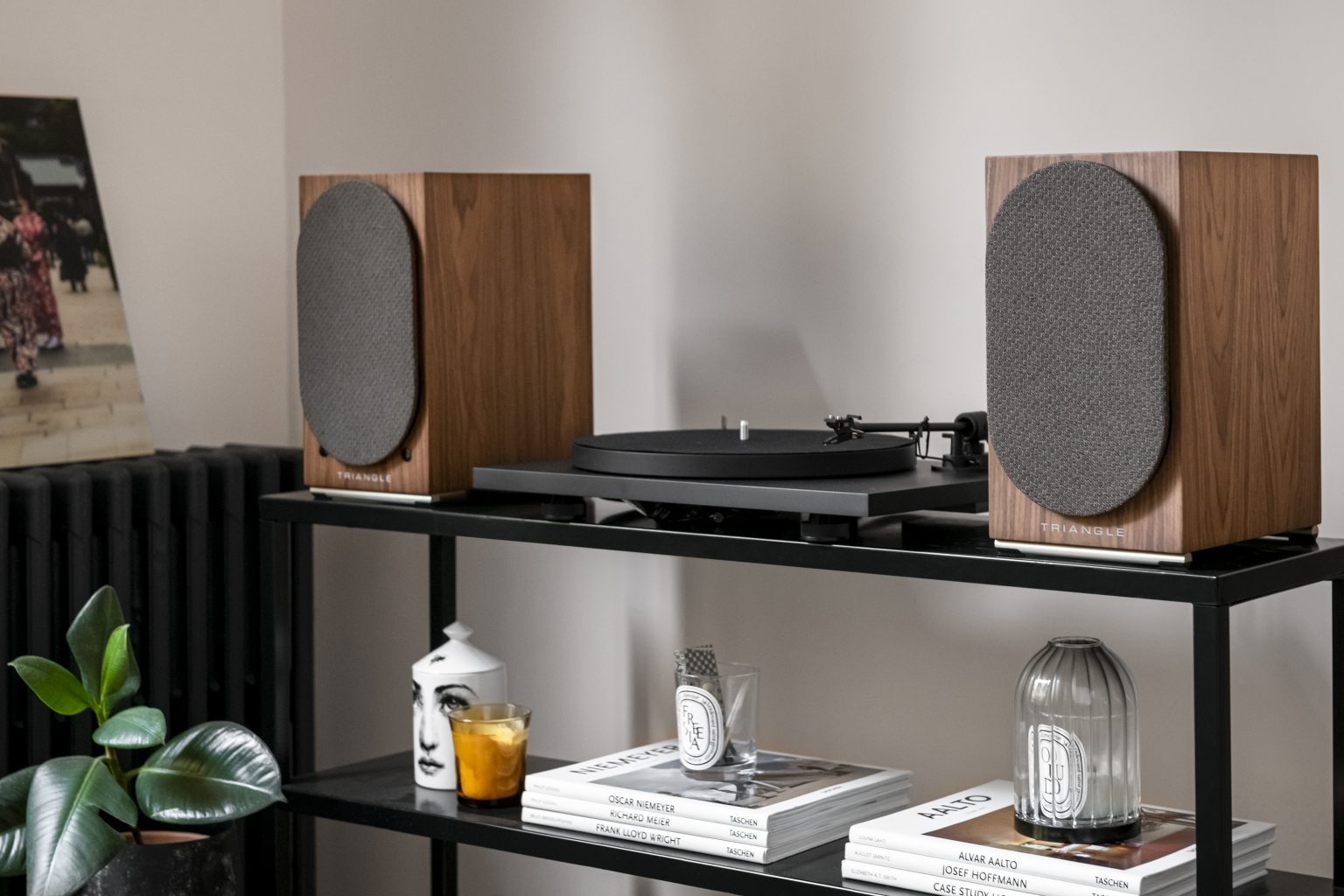
Finishes include Graphite Black, Frosted White, Linen Grey, Abyss Blue, Brown Maple, Eggplant, and English Green, utilizing Gabriel Bond acoustically transparent fabric grilles.
Value Proposition
The system occupies a strategic price position at approximately $1000/£699, undercutting the KEF LSX II by roughly 40% while offering comparable high-resolution streaming capabilities and superior analog input integration (dedicated phono versus none). Against the Elac Debut Connex DCB41 (~$600), the Triangle justifies premium pricing through superior streaming resolution (192kHz versus 96kHz), dedicated app ecosystem, and multi-room expandability.
| Value Factor | Triangle AIO Twin | Competitor A (KEF LSX II) | Competitor B (Elac DCB41) |
|---|---|---|---|
| Cost per Input | High (Phono, Optical, BT, Wi-Fi, Aux) | Medium (No phono) | High (Phono, USB, BT, Optical) |
| Streaming Quality | 24/192 | 24/192 | 24/96 |
| Multi-room Capability | Yes (LinkPlay) | Yes (KEF Connect) | No |
| Finish Options | 7 colors | Multiple | Limited |
| Sub Out | Yes | Yes | Yes |
The inclusion of a moving magnet phono stage—however modest in performance—eliminates the $100-$300 external stage cost for vinyl newcomers, enhancing effective value for analog-curious digital natives.
Versatility & Compatibility
System matching capabilities extend across analog and digital domains. The optical input accommodates television audio output (PCM stereo only), though the absence of HDMI ARC limits CEC control and modern TV integration simplicity. The phono stage accepts standard moving magnet cartridges (specification not confirmed regarding capacitive loading or gain exactitude), suitable for entry-level to mid-tier turntables.
Wireless integration supports Bluetooth 5.0 aptX for universal device compatibility and Wi-Fi for high-resolution streaming via the proprietary app. LinkPlay technology enables grouping with additional Triangle AIO products for synchronized multi-room playback or discrete zone streaming.
Pairing recommendations include:
- Turntable: Pro-Ject Debut Carbon or similar MM-equipped tables (direct collaboration noted with Pro-Ject for matching finishes)
- Subwoofer: Triangle Thetis 340 (designed for aesthetic and sonic synergy) or any line-level RCA subwoofer
- TV: Models with optical output (pre-HDMI ARC era or budget sets)
- Streaming: Qobuz, Tidal HiFi, Spotify Connect, Deezer
Use case limitations include the 3m maximum speaker separation (fixed cable length) and the requirement for the master unit to accommodate all electronics, potentially limiting placement flexibility in asymmetric rooms.
Subjective Pattern Analysis
Sonic character presents as forward and dynamically engaging, with particular emphasis on midrange clarity and vocal presence. The silk dome tweeter exhibits smooth decay characteristics and forgiving high-frequency presentation, avoiding the etch or glare associated with metallic dome implementations. Upper registers display articulate detail without aggressive bite, suitable for extended listening sessions.
The 130mm paper cone woofer delivers textured midbass with moderate extension, though low-frequency authority benefits from subwoofer augmentation in larger rooms or for bass-heavy genres. The concave diaphragm design contributes to rigidity and pistonic behavior, resulting in coherent integration with the tweeter through the crossover region.
Soundstage width exceeds physical cabinet boundaries, creating a convincing stereo image when positioned with appropriate toe-in. The rear-firing bass ports contribute to room coupling that can enhance perceived warmth in moderately sized spaces, though boundary reinforcement requires careful placement to avoid boominess.
Professional reviewers consistently describe the presentation as “enthusiastic” and “capable,” suggesting a tuning bias toward musical engagement rather than analytical neutrality. Treble and bass tone controls (accessible via remote) allow for room-specific tailoring, though purists may prefer direct signal path.
Limitations & Trade-offs
Phono Stage Performance: The integrated moving magnet stage provides convenience but exhibits higher noise floor and lower gain than dedicated external phono preamplifiers. Low-output cartridges or those requiring specific loading may underperform.
Connectivity Constraints: The proprietary 3m speaker cable limits maximum separation between left and right channels and cannot be user-replaced with longer runs without modification. The absence of HDMI ARC restricts modern TV integration to optical Toslink, precluding automatic input switching and volume control via TV remote.
Physical Design: Rear-firing bass ports mandate significant wall clearance (minimum 30cm recommended) to prevent boundary loading and midbass bloom. The rubber isolation pads on aluminum feet demonstrate inconsistent adhesion, with reports of detachment during relocation.
Streaming Ecosystem: While the Triangle AIO app supports major services, it lacks the ecosystem maturity of Bluesound or Sonos regarding third-party integration and voice assistant support.
Thermal and Power: Specification not confirmed regarding thermal throttling behavior under sustained high-output conditions or standby power consumption metrics.
Verdict
The Triangle AIO Twin represents a compelling convergence of traditional hi-fi values—tangible connectivity, stereo imaging, and analog heritage—with modern streaming convenience. For listeners prioritizing vinyl accessibility and high-resolution wireless playback in a compact, aesthetically refined package, it delivers exceptional value despite minor ergonomic compromises.
The system excels as a lifestyle-friendly entry point for vinyl-curious digital natives and as a secondary system for dedicated enthusiasts seeking bedroom or office musicality. While the phono stage and connectivity limitations prevent recommendation for critical analog listeners or home theater-centric installations, the enthusiastic sonic character and versatile input array establish it as a category standout in the sub-$1000 active speaker market.
MyHiFi may earn a commission from purchases made through affiliate links.